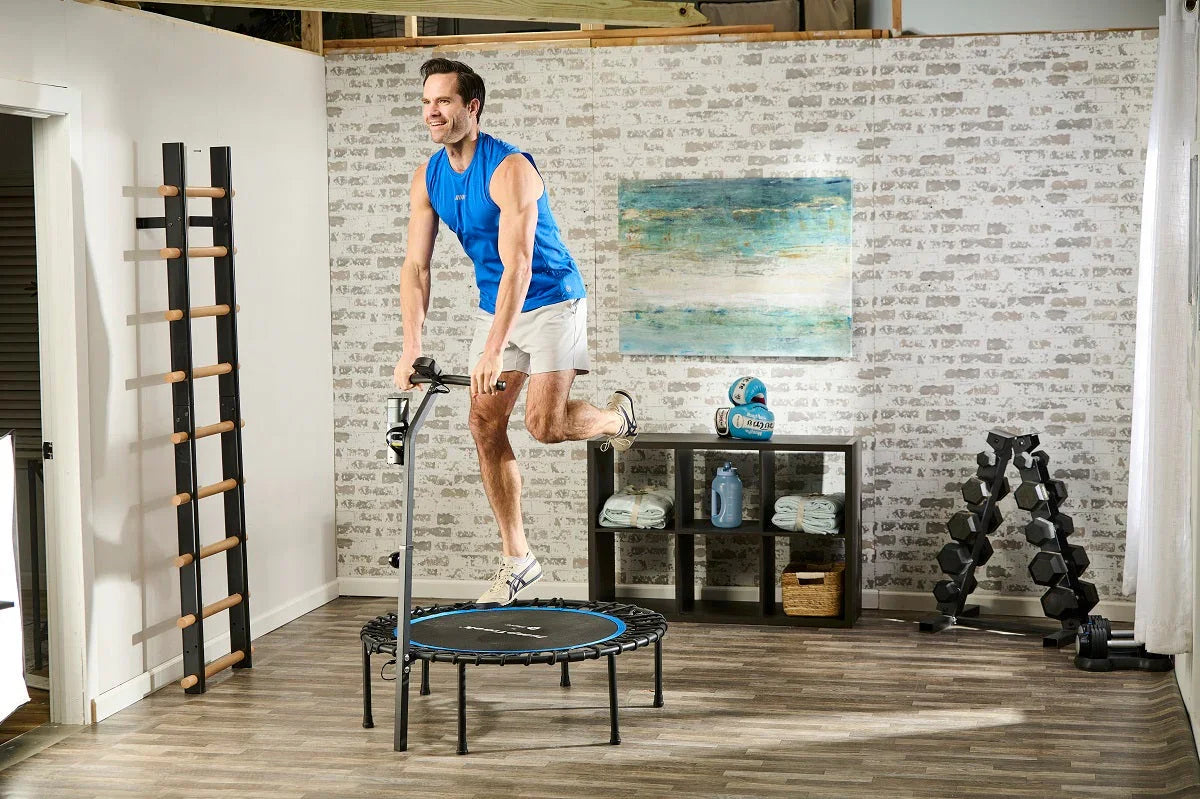
8 Rebounder Exercises for Seniors: A Low-Impact Workout
Rebounding (bouncing gently on a mini-trampoline) is an excellent low-intensity workout because it's effective yet easy on the joints.1 While trampolining is more well-known as a kids' activity, this type of exercise can actually be very beneficial for aging adults.
As with the Lifepro JumpTrack Lite and Pro, a rebounder is an accessible, safe, and fun way to get physical activity. Read on for more on the benefits of rebounding for seniors, along with a roundup of the best rebounder exercises.
Why Rebounder Exercises are Ideal for Seniors
Rebounding exercises are particularly beneficial for aging adults because they offer low-intensity physical activity that improves strength, balance, coordination, and cardiovascular fitness.2,3,4
- Low-impact – Rebounder exercises provide a low-impact alternative to traditional workouts, reducing stress on joints and minimizing injury risk. Discover more low-impact exercise equipment in our blog.
- Strength building – Bouncing on a mini-trampoline engages all the major muscle groups without straining the body. Even light bouncing strengthens muscles, promoting better posture and overall functional strength for daily tasks.
- Improved cardiovascular fitness – Rebounding gets your heart pumping, and over time, it can improve cardiovascular endurance. This can prevent you from feeling fatigued from walking around or upstairs while lowering the risk of stroke, heart disease, and other chronic conditions.
- Improved balance and coordination – If you're consistent with your workouts, you can also expect better balance and coordination. This is essential for seniors who want to stay mobile and avoid falls.

Top Rebounder Exercises for Seniors
The best rebounding exercises for seniors are simple and easy yet effective. Here's what to try when starting your routine.
#1 Basic Bounce
How to do it: Stand in the center of the rebounder mat with your feet hip-width apart. Bend your knees, straighten your legs, and repeat continuously.
Benefits: This foundational exercise is a pillar of rebounder workouts. It's beginner-friendly, good for warm-ups, and helps build stamina, improve joint mobility, and increase blood circulation.
#2 Knee Lifts
How to do it: Alternate lifting your right and left knee to about a 90-degree angle while shifting your body weight from side to side.
Benefits: This move is good for coordination and balance. By engaging the abdominals, it helps build core strength.
#3 Marching in Place
How to do it: Marching in place is similar to knee lifts, except you won't lift your knees as high. You don't even necessarily have to lift your feet off the rebounder mat—you can simply alternate bending each knee to shift your weight from side to side.
Benefits: This simple, low-impact exercise is ideal for beginners and older adults with mobility issues who want to build lower-body strength while protecting their joints.
#4 Side-to-Side Steps
How to do it: This one is similar to marching in place, only you'll shuffle your feet from side to side instead of up and down in a forward motion. As you move your feet, lean into the rebounder mat for gentle bouncing action.
Benefits: Side-to-side steps on a rebounder can improve lateral mobility and agility while strengthening the legs—all crucial for maintaining mobility in seniors.
#5 Rebounder Jogging
How to do it: March or jog in place on the mini-trampoline, using the handlebar for support. Lift your knees higher for added intensity as you get more comfortable and stronger.
Benefits: Rebounder jogging can get your heart rate up and strengthen your legs and lower body—without the impact of regular jogging on a hard surface.
#6 Handlebar Squat Jumps
How to do it: From a standing position, sit back and bend your knees into a squat, then gently bounce up and back to the squat position. Use the handlebar for balance.
Benefits: Handlebar squat jumps work your entire lower body and core while improving balance, coordination, and cardiovascular endurance.
#7 Seated Bounces
How to do it: Sit in the center of the trampoline with your legs crossed or out in front of you, and use your arms and core to initiate a gentle bounce.
Benefits: This beginner-friendly move is ideal for seniors with balance concerns who want to work on their core strength.
#8 Arm Circles
How to do it: While performing gentle bounces or just standing in the center of the rebounder mat, extend your arms straight out to the side and make slow circles.
Benefits: This exercise engages the upper body and core while improving coordination.

How Often Should Seniors Use a Rebounder?
Older adults who haven't exercised in a while can start slowly, with two or three rebounder sessions a week, then gradually increase to four or five times a week.
Even just five to 10 minutes can be enough to strengthen muscles and get your heart rate up if you're new to rebounding. As you get stronger, you can increase the time to 20 or 30 minutes. Just make sure you're getting plenty of rest to avoid overexertion.
Safety Tips for Rebounding as a Senior
Here's what we recommend for staying safe on your rebounder:
- Proper setup – Ensure the rebounder is set up in a stable, non-slippery area (ideally indoors on a hard floor) to avoid accidents.
- Handlebar use – Seniors should opt for a rebounder with a built-in handlebar to help with support and balance while bouncing.
- Footwear – Wear supportive, shock-aborbing shoes to protect your feet and minimize the risk of slipping.
- Monitor for dizziness – If you feel lightheaded or dizzy, stop your routine and check in with a medical provider.
How to Incorporate a Rebounder into Your Fitness Routine
Rebounder exercises can be combined with other low-impact activities, like walking at a comfortable pace, water aerobics, indoor cycling on a recumbent bike, and gentle stretching.
Start slow, go at your own pace, and listen to your body. As always, get in touch with your healthcare provider before starting any new fitness routine.
Rebounders for Seniors: Product Recommendations
JumpTrack rebounders from Lifepro are safe and senior-friendly, with smooth bungee systems, non-slip feet, and an attached handlebar. They're also low-profile, compact, and easy to move from room to room.
Start Rebounding Today for Better Health
Rebounding is an ideal workout for seniors. Backed by a lifetime warranty and self-help resources, Lifepro's JumpTrack Lite and JumpTrack Pro rebounders offer low-intensity, year-round physical activity and the ability to customize a routine to your unique needs and fitness level.
Start your journey today, and bounce your way to a stronger body and improved daily well-being.
Sources:
- Cleveland Clinic. The Many Health Benefits of Exercising on a Trampoline. https://health.clevelandclinic.org/trampoline-workout-benefits
- Clinical Interventions in Aging. Effectiveness of a Mini-Trampoline Training Program on Balance and Functional Mobility, Gait Performance, Strength, Fear of Falling and Bone Mineral Density in Older Women with Osteopenia. https://pmc.ncbi.nlm.nih.gov/articles/PMC6929928/
- Journal of Education Health and Sport. Springing to Life: Unveiling the Transformative Effects of Trampoline Bouncing on Human Health. https://www.researchgate.net/publication/377582938_Springing_to_Life_Unveiling_the_Transformative_Effects_of_Trampoline_Bouncing_on_Human_Health
- Sports Medicine-Open. Effect of Low-intensity Exercise on Physical and Cognitive Health in Older Adults: a Systematic Review. https://pmc.ncbi.nlm.nih.gov/articles/PMC4612316/
- Libyan Journal of Medicine. The effect of rebound exercise on cognition and balance of females with overweight and obesity. https://www.tandfonline.com/doi/full/10.1080/19932820.2024.2438513?src=exp-la
- National Institute for Fitness and Sport (NIFS). Bounce Your Way to Better Health: The Benefits of Rebounding for Senior Citizens. https://wellness.nifs.org/blog/bounce-your-way-to-better-health-the-benefits-of-rebounding-for-senior-citizens
- Cureus. Rebound Exercises in Rehabilitation: A Scoping Review. https://pmc.ncbi.nlm.nih.gov/articles/PMC11296216/
- Journal of Nutrition, Health and Aging. International Exercise Recommendations in Older Adults (ICFSR): Expert Consensus Guidelines. https://www.sciencedirect.com/science/article/pii/S1279770723007881
- International Journal of Behavioral Nutrition and Physical Activity. Impact of physical activity programs and services for older adults: a rapid review. https://ijbnpa.biomedcentral.com/articles/10.1186/s12966-022-01318-9
- National Council on Aging (NCOA). The Life-Changing Benefits of Exercise After 60. https://www.ncoa.org/article/the-life-changing-benefits-of-exercise-after-60/
- Journal of Physical Therapy Science. Does trampoline or hard surface jumping influence lower extremity alignment?. https://pmc.ncbi.nlm.nih.gov/articles/PMC5890218/